
Early County Recent Arrest Channels
The Early County Sheriff's Office publishes no searchable inmate roster. There is no 24-hour booking page either. No running arrest log appears on the official site. Its detention page offers facility and contact details, and not much else besides. Visitors find no search field, results table, timestamp, or photo rule there. That gap matters. A name on a third-party site should never be read as live jail status. For present custody, call the Early County Jail at 229-723-3150. A past booking goes through the sheriff's records route.
Two windows serve different needs. The Arrests Last 24 Hours guide covers the same-day confirmation path. The Police Blotter guide covers longer spans, news reports, and older records. Neither invents a feed Early County does not provide.
| Window | Official online view | Best route |
|---|---|---|
| Same day | None located | Call the jail for current custody |
| Several days | No county blotter located | Ask ECSO for the booking record |
| After release | No release archive located | Use Open Records and the court clerk |
Arrested Overnight in Early County
How fast does overnight booking data appear? No official Early County source promises a schedule. Fingerprinting, medical intake, identity checks, charge entry, and bond processing all happen first. Staff may need time to confirm every detail. So start with a call: ask for the front jailer, spell the full name, and ask whether the person is held now. If the jail cannot confirm an older event, call 229-723-3577 for Open Records routing. An empty web search proves nothing at all.
VINELink can back up the call. Georgia's VINELink service covers a name when a record appears in it, though public Early County sources do not confirm that every local booking enters VINE. The VINELink Custody Check page explains how to search one name and register for an alert.
Timing shifts with the question asked. Jail staff may confirm custody before the full booking sheet is ready for release. Bond details can change after a first appearance. A transfer can make yesterday's answer stale. Answers go stale. So note the time of each status check and the agency that supplied it. For an overnight arrest, check again with the clerk once a case number or first court date exists, since that keeps the early arrest record separate from the later court file.
Early County Arrest Roster Limits
The Early County Sheriff's Office posts no jail roster. Its jail pages have none. The public-resource pages and navigation menus have none either. So no public search fields, update schedules, or photo rules exist to describe. The jail phone line still helps. Ask whether the person is in custody now, whether a transfer occurred, and which office holds the booking record.
| Requested detail | What to provide |
|---|---|
| Identity | Full name and other lawful identifying details |
| Booking event | Approximate arrest or intake date |
| Agency | ECSO, Blakely PD, Arlington PD, or Damascus PD if known |
| Custody status | Ask whether held, released, or transferred |
| Record or photo | Request the specific booking and the legal response |
Start with the jail line for a live status. Open Records comes next for a copy. The clerk handles the later case result. CodeRED Mobile Alert is the only app-like tool the sheriff's office links, and it sends emergency notices tied to an address. It is not a jail roster, arrest app, release service, or mugshot source. The detention page on the sheriff's site documents the jail contact rather than any roster.

The sheriff's detention page shows where to call. It also shows why a custody check matters. Each number has its own job. The main office answers at 229-723-3484. The front jailer takes custody questions at 229-723-3150. The sheriff directory assigns 229-723-3577 to dispatch, warrants, and records. State and county pages do not agree on every contact label. Describe the request up front. Ask staff to route custody questions to the jail. Document requests go to the record custodian. A commercial directory is never more current than the agency's own listing.
Early County Arrest App Limits
The sheriff's office links CodeRED emergency alerts and points to the CodeRED Mobile Alert app. The service sends location-based public safety notices about urgent events near an address. It does not list people arrested. It shows no booking photos. It tracks no releases and searches no Early County Jail. Anyone treating CodeRED as an inmate app will read silence as a false negative.
For one person's custody status, use the jail phone first. VINELink comes second. For a booking document, use Open Records. For the charge outcome, use the court clerk. These are three different questions. Each channel answers its own. All three trace back to the same arrest. An emergency alert about a police event, likewise, is not proof that anyone was booked.
The official CodeRED page shows the alert service the sheriff's office actually names.
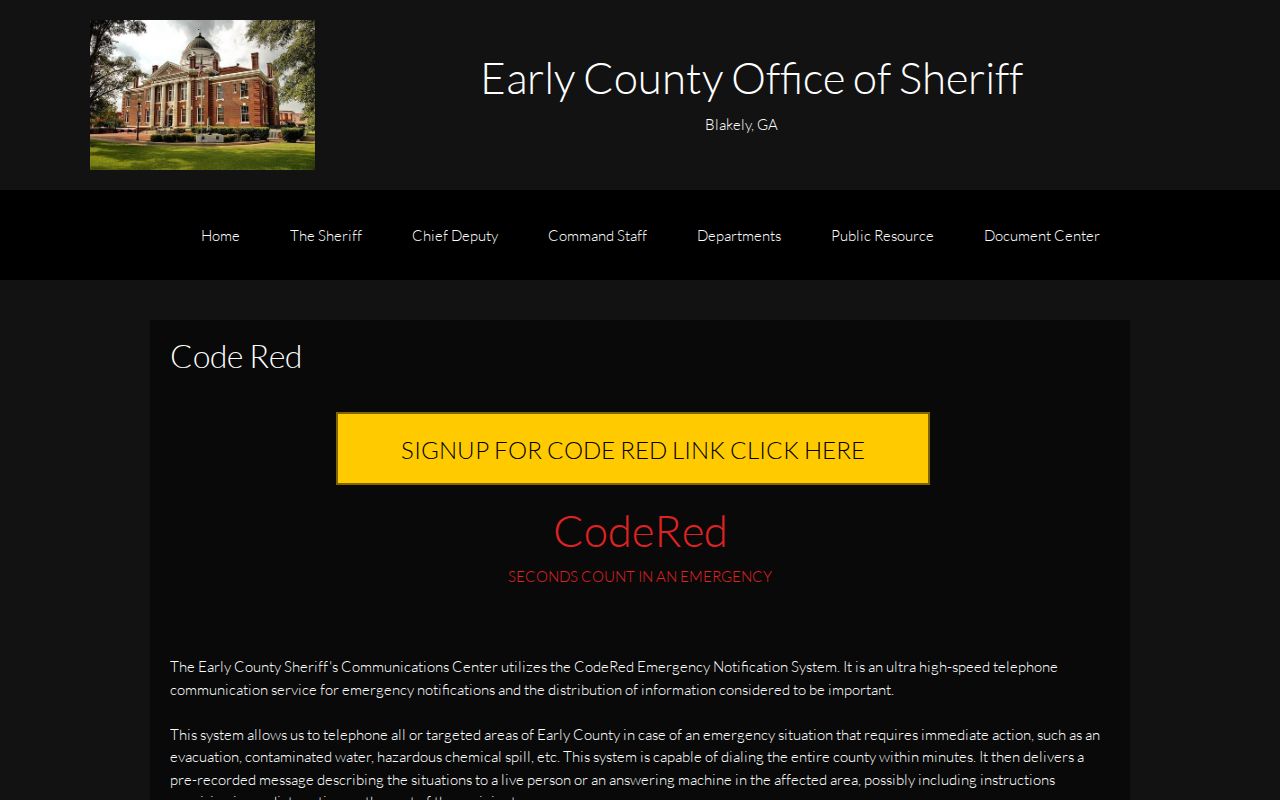
What the notice describes is an emergency communication tool, not an arrest feed or any kind of public jail roster.
Where Early County Arrests Surface
Start with the official sources. The Early County Sheriff's Office holds current custody and booking records. A city police department keeps its own incident reports. Court filings belong to the Pataula Judicial Circuit clerk. GDC covers the sentenced state-prison side. Federal systems run separately through BOP and ICE. News outlets cover selected Early County arrests, but none maintains a complete county register.
| Channel | Scope | Photo status |
|---|---|---|
| ECSO jail and records | Current custody and local booking files | Specific photo requests are decided under Georgia law |
| City police | Agency incident report | No local public gallery found |
| Early County clerk | Court docket and disposition | Not a booking-photo service |
| GDC Find an Offender | State correctional cases | Photo may be available |
| WALB and WTVY | Selected news stories | May use an agency-supplied image |
| Commercial directories | Unofficial and possibly stale | Not authoritative |
Commercial sites claim broad Early County coverage. Some Georgia indexes skip the county entirely. Those gaps leave them weak proof of who is actually in custody. Secondary links below map the local online landscape and endorse nothing. Take any lead back to the agency that created the record.
Recent Arrests by Early County City
Blakely Recent Arrests covers the county seat. It also gathers Blakely Police Department reports and bookings that may land in Early County Jail. Arlington Recent Arrests needs a second county check. The city straddles the Early-Calhoun line. Damascus Recent Arrests traces a simple small-city path. It runs from Damascus PD to ECSO and then the clerk. Match the arresting agency and the place of arrest, not just the city name.
Arlington is the trap to watch. The city sits in both Early and Calhoun counties. An Arlington address alone tells you nothing about which jail, sheriff, or court holds the record. Ask which side of the line the arrest happened on. Then ask which agency did the transporting. A Calhoun answer matters here. An Early County jail call may rightly come back empty even though someone was arrested in Arlington. Blakely and Damascus searches still deserve a quick agency check. State or federal arresters can use a different custody path.
Inside an Early County Arrest Record
A booking record simply documents intake into the jail. It stands apart from an incident report. It is not a criminal-history report, a court judgment, or a sentence. ECSO posts no sample entry online. Treat the common booking fields as a request checklist. Ask only for details that identify the event and help the custodian find it.
| Field | What it may show |
|---|---|
| Name and booking number | The identity and jail intake reference |
| Booking date and time | When intake was recorded |
| Arresting agency | The office that made or delivered the arrest |
| Charges | Charges entered at booking |
| Bond | Terms recorded at that stage |
| Release or transfer | A later custody event, not the case outcome |
| Booking photograph | An intake image, subject to release rules |
Early County Mugshots and Arrest Photos
ECSO posts no public photo roster. It states no photo policy. Georgia law limits which booking photos a law-enforcement website may publish. It also bars supplying an image to any site that charges people for removal. A photo missing online proves nothing about whether one was taken. Request the specific image from the custodian. If it is redacted or withheld, ask for the legal basis.
The Georgia Department of Corrections Find an Offender service may show a state correctional image. That happens when one exists. That image belongs to the state-prison record. It may differ from the Early County intake photo. GDC states plainly that it does not provide county jail sheets. Some First Offender Act matters carry publication limits. No booking-photo gallery or rehosted face appears here.
Request Early County Arrest Records
The ECSO Open Records page lists 229-723-3577 but no local form, fixed fee, or production promise. Georgia's Open Government guidance requires a response inside three business days that either produces available records or explains the timing and any lawful withholding. That is a notice rule, not a promise every record arrives within three days.
- Identify the person, date range, arresting agency, and likely booking date.
- Ask for the booking sheet, release or transfer entry, and a specific photo only if needed.
- Call the published records number to confirm where and how to submit the request.
- Ask for an estimate before costs are incurred and request the cited exemption for any withholding.
- Keep the response with the later court disposition so the charge retains context.
The county request entry appears in this capture and can help route county-held material.
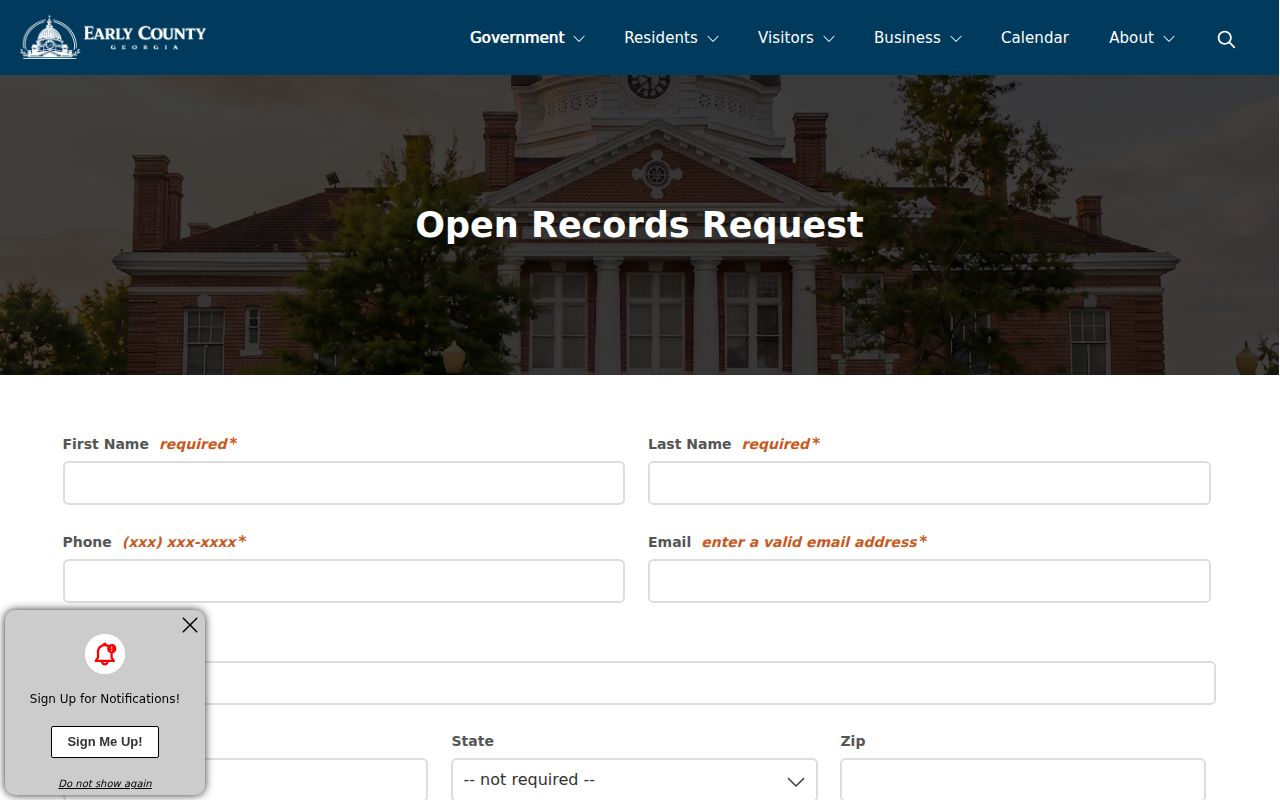
Still check the displayed county entry against ECSO's own records contact for sheriff and jail files.
Georgia Law on Arrest Photos
O.C.G.A. § 35-1-19 governs law-enforcement website publication and certain booking-photo requests. Free-removal rules for qualifying commercial mugshot publishers come from O.C.G.A. § 10-1-393.5, while Open Records Act exemptions sit in O.C.G.A. § 50-18-72. Juvenile, victim, medical, fingerprint, sealed, restricted, and active-investigation material does not get treated like an ordinary public booking field.
To correct or restrict a record, start with Georgia Courts record-restriction guidance and the GBI process. An order limiting agency dissemination will not erase a newspaper archive. It will not erase a private copy on its own. For an outside publisher, use its free correction process. Keep proof of delivery. Never pay a removal intermediary.
Georgia's consumer rule applies once its stated qualifying conditions are met. A request generally needs enough detail to identify the image. It must also show why removal is due. That proof might be that the charge was dismissed, restricted, or otherwise covered by the law. Send it through whatever method the publisher currently provides. Then retain the URL, request date, delivery record, and reply. The official process costs nothing. A company demanding payment should never replace the Georgia Attorney General's complaint and statutory path.
The Georgia Attorney General guidance shown here lays out the state's consumer protections for mugshot websites.
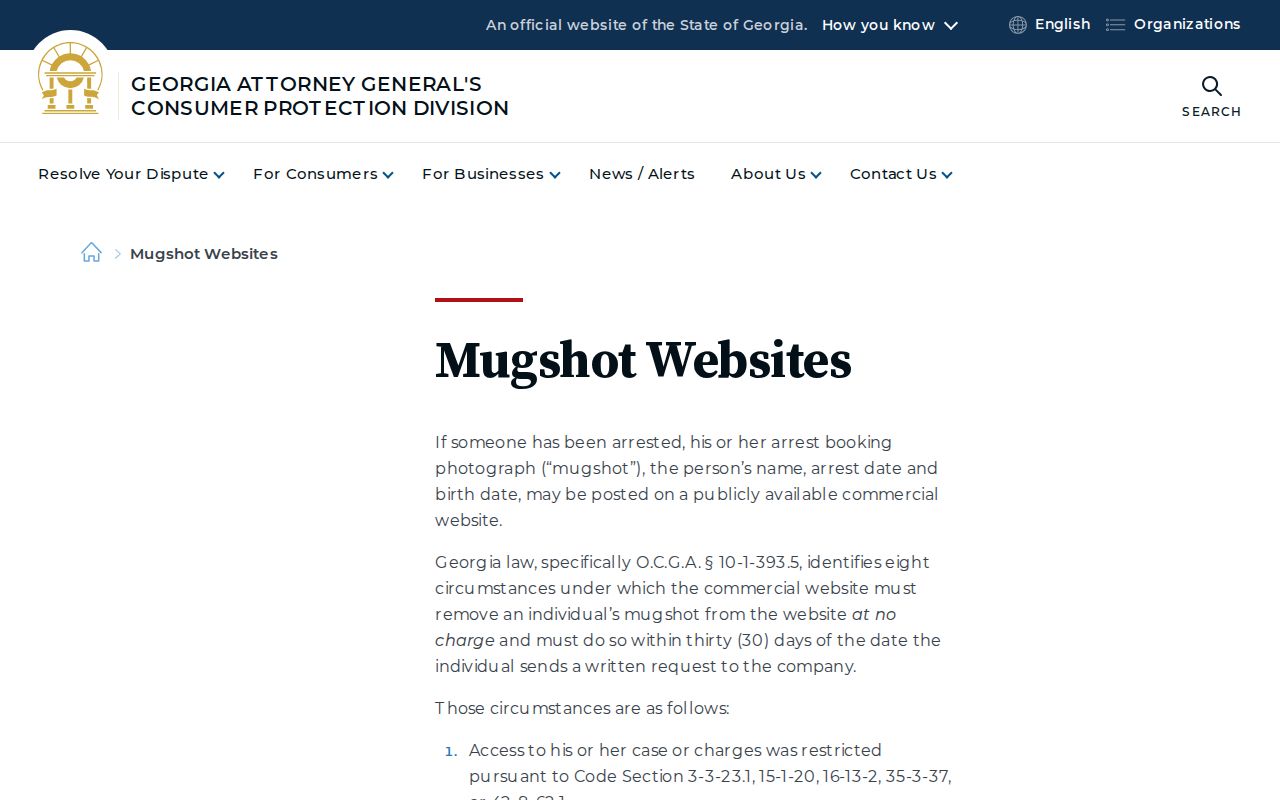
The official guidance is your starting point for a qualifying free request, not a paid removal service.
Early County Arrest Warrants
Early County offers no online warrant-search portal. The ECSO keeps no most-wanted page either. Georgia's warrant guidance notes that county procedures differ, and it warns that an in-person inquiry can end in custody if a warrant exists. So call 229-723-3577 first. Ask the sheriff which identifiers and steps a warrant check requires. The clerk handles court-record questions. A docket entry, though, does not always confirm a live warrant.
Never confront someone you believe is wanted. Call 911 for immediate danger. For non-emergency matters, use the sheriff's published line, and anyone who thinks a warrant carries their own name should contact a lawyer or the court.
The ECSO posts no official most-wanted list, wanted-person photos, tip form, reward program, or "Warrant Wednesday" feature. CodeRED does not fill that gap. A news story asking for tips may track an open investigation rather than a warrant a judge has signed. Give tips only to the agency named in the notice or report, and never use a photo or name to confront, follow, or publicly accuse anyone.
Early County Arrests Reach Court
After an arrest in Early County, the case moves from the jail to the courthouse. Booking is only the start. The Pataula Judicial Circuit clerk page gives the Early County Superior and State Court clerk's location. It is 111 Court Square, Suite C, Blakely. The phone number is 229-723-3033. Call for case-status answers. Ask for the court, the case number, the filed charge, and the disposition. Disposition simply means the recorded result. It can differ from the wording logged at booking. A charge may be changed, dismissed, resolved by plea, or decided at trial.
Early County does not appear among the courts listed on the Georgia Courts eAccess participation page. So calling the clerk beats trusting a private search ad. That ad poses as the official court. The jail answers one question; the clerk answers another. Someone can be released and still have an open case. They may also be transferred out of the Early County jail while the county docket stays active. Write down each date and each source beside every status. That habit keeps a same-day jail answer from being confused with a final outcome.
Unofficial Early County Arrest Sites
Official channels come first in Early County. Third-party arrest sites sit far down that list. The Mugshots.com Early County section holds older secondary records rather than a live ECSO roster. The RecentlyBooked Georgia index lists no Early County entry at all. Early County is absent from the Arrests.org county list too. Busted Newspaper has no live Early County section. Mugshots.zone gives no county-specific coverage either. None of those gaps proves that nobody was arrested in Early County.
JailExchange has an Early County recent-bookings page. Yet it is an unofficial directory. Its contact details clash with official sources. It does not prove ECSO runs any web roster or photo feed. WALB's Early County stream and event-based WTVY reports cover selected arrests and wanted-person notices. News coverage is edited and selective. It cannot show every Early County booking. Nor does it guarantee a later disposition update. Early County News and the Georgia Historic Newspapers collection suit older reporting better. They fit history more than current custody.
When an unofficial record surfaces, save its URL and date. Do it right away. Then confirm the agency, booking date, custody status, and court result. Check with ECSO or the clerk of court. If the publisher offers a free correction or removal path, use it with official paperwork.
Beyond Early County Arrest Custody
GDC answers one narrow question: where a person sits in state custody after sentencing and transfer. Search it by name, GDC ID, case number, or other descriptive fields. The result shows custody, release, or another status. A fresh Early County arrest rarely shows up there. For federal prisoners, the BOP Inmate Locator reaches back to 1982, though it posts no public booking photos. ICE runs a separate locator for immigration detention. None of these substitutes for calling the ECSO jail.
Release changes custody only. The paper trail survives. A booking record, court case, or news story can outlast the jail stay itself. Georgia Archives retention schedules sort these into distinct series: arrest, jail, warrant, and video. Retention rules say nothing about web display, though. An entry that vanishes from a county site proves nothing about the underlying case.
The statewide schedule spells out the timers. Jail booking records stay on the books for 10 years after release. Jail registers last 10 years after the final entry, while daily incarceration lists drop off after one year. Arrest summary statistics and cash bond dockets carry five-year periods. Transfer and extradition files also get five years. Holding-cell video goes fastest, at just 180 days. Warrant and investigation files sit in their own series. These windows guide record management. They do not confirm that any given Early County file exists, stays public, or has landed in the Georgia Archives.
For an old arrest, go to the office that made or kept the record. ECSO handles jail booking and register material. The city police department holds its incident report. The Early County clerk keeps the case file. Give each office a precise date range and name the record series when you can. If short-lived evidence like holding-cell video matters to a legal dispute, a lawyer can file a prompt preservation request. Old newspaper clippings may offer leads, but the court record supplies the context that counts.