
Early County VINELink Coverage
Georgia brought automated VINE victim notification statewide in 2024 through its Criminal Justice Coordinating Council. The official launch announcement lays out online, telephone, and mobile access for covered custody events such as arrest, release, and escape. Later state materials note that agencies joined in phases. None of that settles the local question. Public Early County sources do not confirm that every Early County Jail booking flows into VINE, and no Early-specific CJCC directory entry does either. The honest status is unverified from a public Early County source. Calling VINE unavailable goes too far in one direction. Promising full coverage goes too far in the other.
Search Early County on VINELink
Search for one person at a time. Then confirm which agency reported the record. The interface runs on JavaScript, so labels and fields can shift between visits. Spelling counts for a lot here. A common name may return several matches, and an empty result can reflect timing or coverage rather than true absence of custody.
- Open the official Georgia VINELink search.
- Select Georgia and test Early County if a county choice appears.
- Enter the person's name or identifier requested on screen.
- Compare available identifiers before accepting a match.
- Read custody status, reporting agency, and event date together.
- Call ECSO when the result is missing, unclear, or stale.
The captured Georgia interface shows the official starting point.

The screen is a search and alert tool for covered custody records, not an Early County booking-photo gallery.
Early County VINE Result Fields
Every field on a result describes the VINE record at one moment. It says nothing about the final court outcome. Check the event date before acting on any status. Compare the listed agency or facility against the Early County source you expect.
| Item | How to read it |
|---|---|
| Name or record ID | Helps distinguish people with similar names |
| Custody status | Reports held, released, or transferred status as supplied |
| Agency or facility | Identifies the source behind the event |
| Event date | Shows when the reported change occurred |
| Notification option | Connects registration to that particular record |
A "Released" flag means that particular custody ended. It does not mean the charge went away or the person was cleared. "Transferred" points to another authority or facility now holding the person. A blank result carries its own limits. Misspellings and data delays can hide a person who is still in custody. So can uncovered county records. Protected matters and moves outside VINE's scope matter too.
Register Early County VINE Alerts
Registering attaches alerts to one matched record. Use only the methods shown on the live screen. State materials list phone, text, email, and mobile access, though the real choices depend on the record and the current interface. A registration done by telephone may ask for a four-digit PIN or a similar check.
- Open the notification control on the correct matched record.
- Select phone, text, email, or app when offered.
- Create the PIN or verification requested by the service.
- Choose the available custody events that matter.
- Save the confirmation or registration reference.
- Keep direct jail and emergency contacts available.
The captured state-selection entry leads into search and registration.
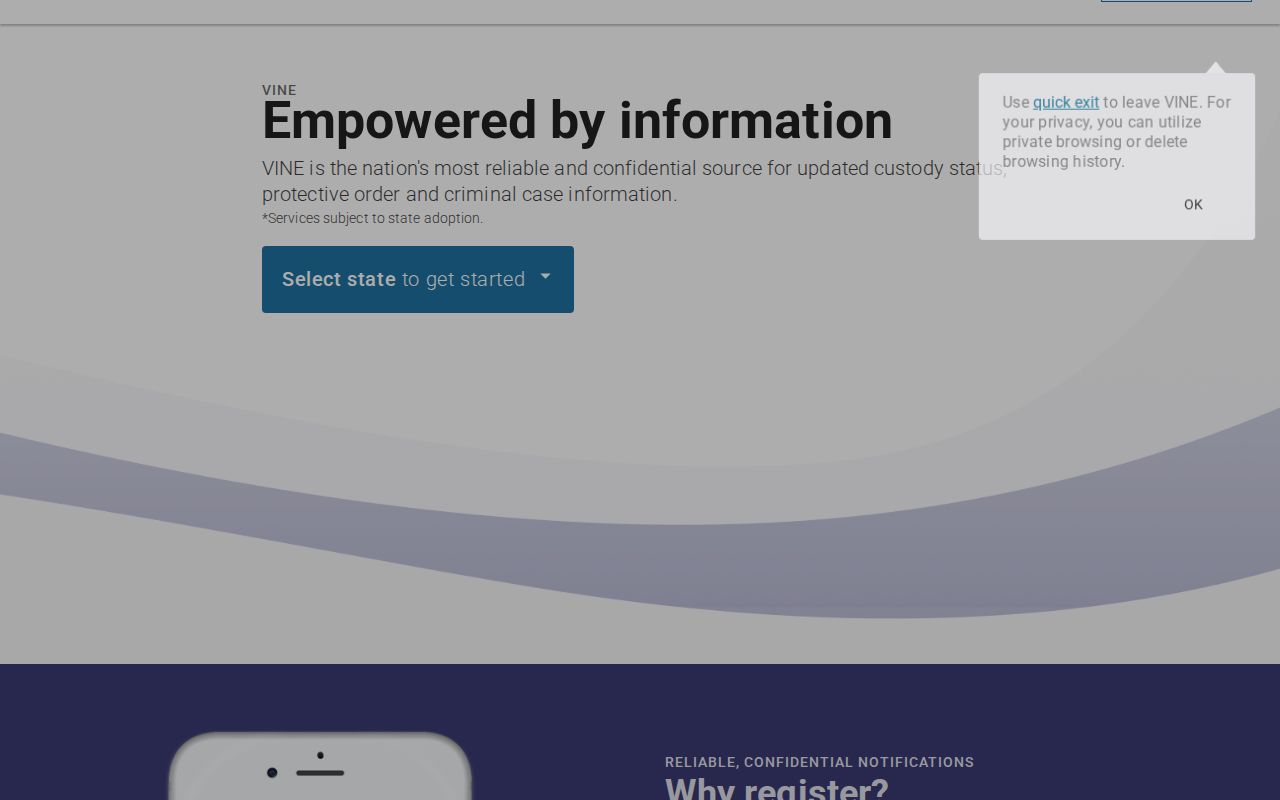
The matched record itself controls which alert channels and event choices you can select. Save your reference number. If an expected notice never arrives, check the record online and call the reporting jail. VINE supports safety planning and custody awareness. It cannot replace direct confirmation when timing matters. Keep the notification destination in the registrant's own hands. Follow the current screen to change a phone number, email address, PIN, or event choice. When several people share a similar name, go back to the source identifiers. Do that before touching the registration. Never assume one person's alert describes another with the same name.
Early County VINE May Have Gaps
Statewide availability and verified county coverage are two different things. Georgia runs VINE. No Early County public source shows that every ECSO intake connects to it. Coverage can also vary by event type. One person's record appearing proves nothing about all bookings. Fresh intake creates another gap. The sheriff's site makes no intake-to-posting promise for any public system. Call the Early County Jail when someone may have just arrived. The front jailer answers at 229-723-3150, and dispatcher or records routing runs through 229-723-3577. Never wait on a digital alert in an emergency. For a direct check on new arrests, Arrests Last 24 Hours is the next stop. That page walks the steps when VINELink returns nothing.
- VINE match
- Read the agency, event date, and custody status together.
- No match
- Try spelling and identifiers, then call the jail.
- Release notice
- Confirms a reported custody event, not a court disposition.
- Transfer notice
- Follow the receiving agency for the next custody check.
Early County Alert Systems Differ
CodeRED Mobile Alert is the ECSO's named mobile resource. Its official CodeRED page covers emergency notices tied to a 911 physical address. Booking, bond, release, transfer, warrant, and booking-photo alerts are not part of that promise. VINE and CodeRED simply serve different purposes.
| Channel | Purpose | Key limit |
|---|---|---|
| Georgia VINELink | Covered custody searches and event alerts | Complete Early County participation is not publicly verified |
| ECSO CodeRED | Address-based community emergency notices | Not a custody or arrest lookup |
| Early County Jail phone | Direct current county-custody check | Not a court disposition or archive |
| ECSO Open Records | Request for a booking document or photo | Not a live alert service |
No official ECSO social account works as a complete booking feed. A post or news item may spotlight one event. Treat it as a lead, not a jail status check. For urgent danger, call 911. For a routine custody question, call the jail. Those direct routes stay necessary even after a notification registration succeeds.
Early County VINELink Limits
Start with what VINE actually does. It checks custody status, nothing more. The service is not a booking-photo archive, a warrant search, or a court docket. Some counties, bookings, juvenile matters, releases, and transfers never appear in it. Federal custody sits outside its reach entirely. The Bureau of Prisons runs its own locator. Immigration detention works the same way, with a separate ICE system. None of those tools replaces a direct Early County search.
So where do you turn? The Early County jail answers the present-custody question. ECSO Open Records handles historical booking records and any releasable photograph. What happened in a case after the arrest? The Early County Superior and State Court clerk holds that record. Keep these channels separate. A person can walk out of jail. The case may still be moving through the courts.
When you need a durable arrest record, take the ECSO Open Records route. Then call 229-723-3577 for request routing. Ask by full name, approximate booking date, arresting agency, and record type. Expect no form, no fee schedule, and no guaranteed turnaround on the local page. A written response can preserve booking facts. They last long after a live custody service stops showing them.
The official Early County Jail page stays the direct source for county custody. The front-jailer line is 229-723-3150. No searchable roster appears there. That gap is exactly why a VINE result deserves a phone call. Skip the second county screen.
Once custody is settled, the Early County clerk listing leads to the court record. A disposition is simply the final recorded result at that stage of a case. VINE may report a release or transfer. It cannot tell you whether the charge was later changed, dismissed, or resolved. The Early County recent-arrests hub ties custody status to booking records and lawful photo requests.