
Early County Blotter Sources
The sheriff's office publishes no 72-hour, weekly, or multi-day arrest log. Its jail page carries no archive, no results table, and no photo rules. Blakely, Arlington, and Damascus police post no blotter either. A dated records request to the sheriff is the official route. Ask for a multi-day booking register that way.
Each office holds a different piece of the puzzle. The sheriff holds the jail booking record. The arresting city department holds its incident and arrest report. The Early County Superior and State Court clerk keeps the later docket and outcome. News adds context. But editors pick which stories run. No outlet records every single arrest or covers every release.
Trace an Early County Arrest
Keep four dates straight when you trace an Early County arrest. The event, the arrest, the booking, and the publication dates all differ. A Tuesday story can describe a weekend incident. Booking may have happened after midnight. The court date sits at a later stage still. Search only one date and you risk missing the right record entirely.
- Record the event date and the story's publication date.
- Identify the arresting agency and county.
- Call the Early County Jail for present custody.
- Request the booking sheet and incident report from their custodians.
- Ask the clerk for the case disposition.
Blotter entries are just a start. Charges can shift after booking. A news story may repeat what police announced that day, while the court file shows what happened weeks later. Release, transfer, and dismissal all change the picture. When the arrest may have happened today, Arrests Last 24 Hours points to direct custody checks instead of the longer paper trail.
Early County Arrest Log Fields
The county publishes no sample entry, so think of these as request and comparison fields rather than promised columns. A narrow request should name a date range and the record series you need. It should also distinguish jail booking records from police incident reports and court files, since each lives in a different office.
| Field | Official check |
|---|---|
| Name and booking number | ECSO booking record |
| Arrest and booking dates | Agency report and jail sheet |
| Arresting agency and location | Incident or arrest report |
| Charges as booked | Booking charges, then court docket |
| Bond, release, or transfer | Jail record for that point in time |
| Case number and disposition | Early County court clerk |
| Booking photograph | Specific lawful request to the custodian |
ECSO posts no photo gallery. It lists no web photo policy either. Georgia law limits some law-enforcement publication of booking photos and some photo supply. Ask for a specific record. Accept lawful redactions rather than assuming every artifact must appear online. A booking photograph belongs with its charge and disposition context.
Early County News Arrest Coverage
WALB's Early County section is the strongest regional news stream for the county. Stories there are dated and bylined. Some carry police-supplied images. That helps identify an incident or agency. But WALB is not an ECSO register and does not promise full coverage. WTVY also runs event-driven reports. Its Blakely shooting report shows how selective that pattern is.
That story ties one reported arrest to the Early County Jail. It is a single incident report, not a multi-day log. News works well for discovery. Confirm custody with the jail. Match the case result with the clerk. A release, transfer, or amended charge may never reach the original article. The same holds for a dismissal, acquittal, or plea.
Early County Weekend Posting Gaps
ECSO follows no weekend or holiday posting schedule. Claims that Friday-through-Sunday bookings surface together on Monday have no official basis. Nor is there a fixed daily export hour or a set posting delay. A missing Monday entry may simply mean no public feed exists. It does not mean nobody was arrested.
Editorial timing varies as well. A newsroom may wait for an agency release. It may cover only a major incident, or update a story later. Holiday staffing can slow publication without touching the jail record. Build a date range around the event. Request the official record instead of reading story volume as arrest volume.
Unofficial Early County Booking Leads
Official sources come first in Early County, though two commercial pages target the county: a JailExchange recent-bookings page and a Mugshots.com county section. Neither belongs to the ECSO. Listings there can be stale, duplicated, or plain wrong. The Mugshots.com Early County section shows just how thin that unofficial booking landscape really is.
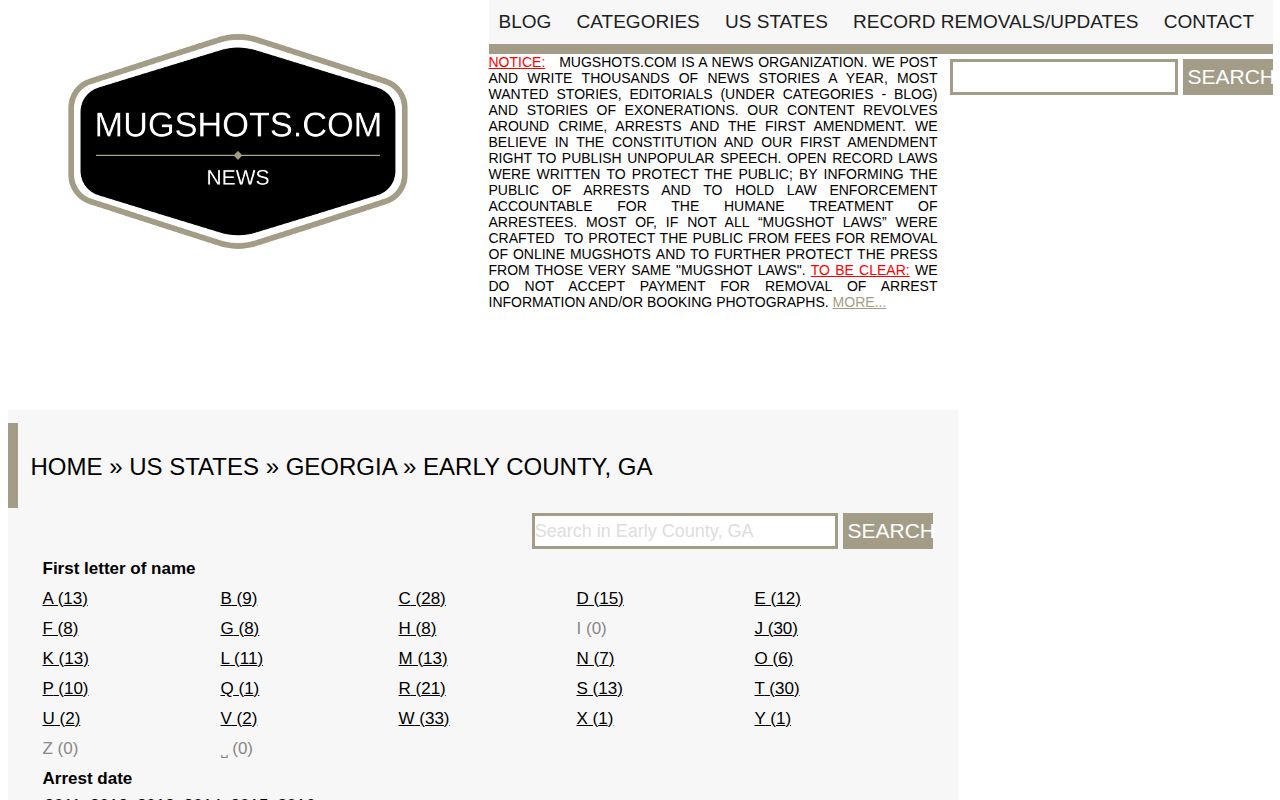
That page appears only to illustrate an unofficial county section. It is not a current roster. Nor is it a gallery to browse. Busted Newspaper offers no live Early County page. RecentlyBooked, Arrests.org, and Mugshots.zone list no verified local section either. Never swap in another county or a statewide result. When an outside lead appears, keep its date and agency claim. Then verify both identity and status through ECSO and the court.
Early County Arrest Archives
How long does a county keep its arrest paperwork? It depends on the record series. The Georgia Archives local retention schedule sets the terms for Early County agencies. Booking records stay on file for ten years after release. Jail registers last ten years past the final entry. Daily incarceration lists survive one year. Summary statistics carry a five-year schedule. These rules govern storage, not what appears on a website.
Older material takes legwork. Ask ECSO Open Records about old booking material from a named span of years. The arresting police agency holds its own report. The clerk of court holds any later outcome. Early County posts no digitized jail-register collection and publishes no official roll-off destination for transferred files.
For depth, the Georgia Historic Newspapers Early County News archive offers decades of older reporting. It also adds community context. A newspaper story is not proof of custody, though. The detention page on the sheriff's site shows the current jail-information endpoint.

The sheriff's site offers one custody contact and nothing beyond it.
Retention is storage. Publication is a separate question, since juvenile, medical, victim, and active-investigation files can stay closed even when routine booking fields are open.
For anything past the missing web window, use ECSO Open Records and call 229-723-3577. Give the start and end dates. Say whether you want jail booking records, a jail register, or an incarceration list. Request an electronic copy if one exists. Ask for a cost estimate first. The page publishes no form, no fee schedule, and no special response promise.
Court outcomes live elsewhere, and the Pataula Judicial Circuit clerk route is where to look for disposition records. A disposition is the result a court recorded. It can show a charge changed, dropped, or resolved. The clerk and jail answer different questions. A complete multi-day arrest trail in Early County often needs both offices.
The Early County recent-arrests hub has the wider picture. Booking records, photographs, warrants, and court context all appear there.